For organizations that work with people coming home
Free and Forward puts documents, deadlines, appointments and jurisdiction-specific next steps on the phone of the person you supervise. The free tier costs them nothing and always will — and we will not claim it does more than the evidence supports.
FREE FOR EVERY PERSON, ON DAY ONE
No cost to them and no cost to you. Nothing to procure, no contract to sign, no account for your office to manage and no data flowing back to us. They download the app and these four are already there, in English and Español.
Free

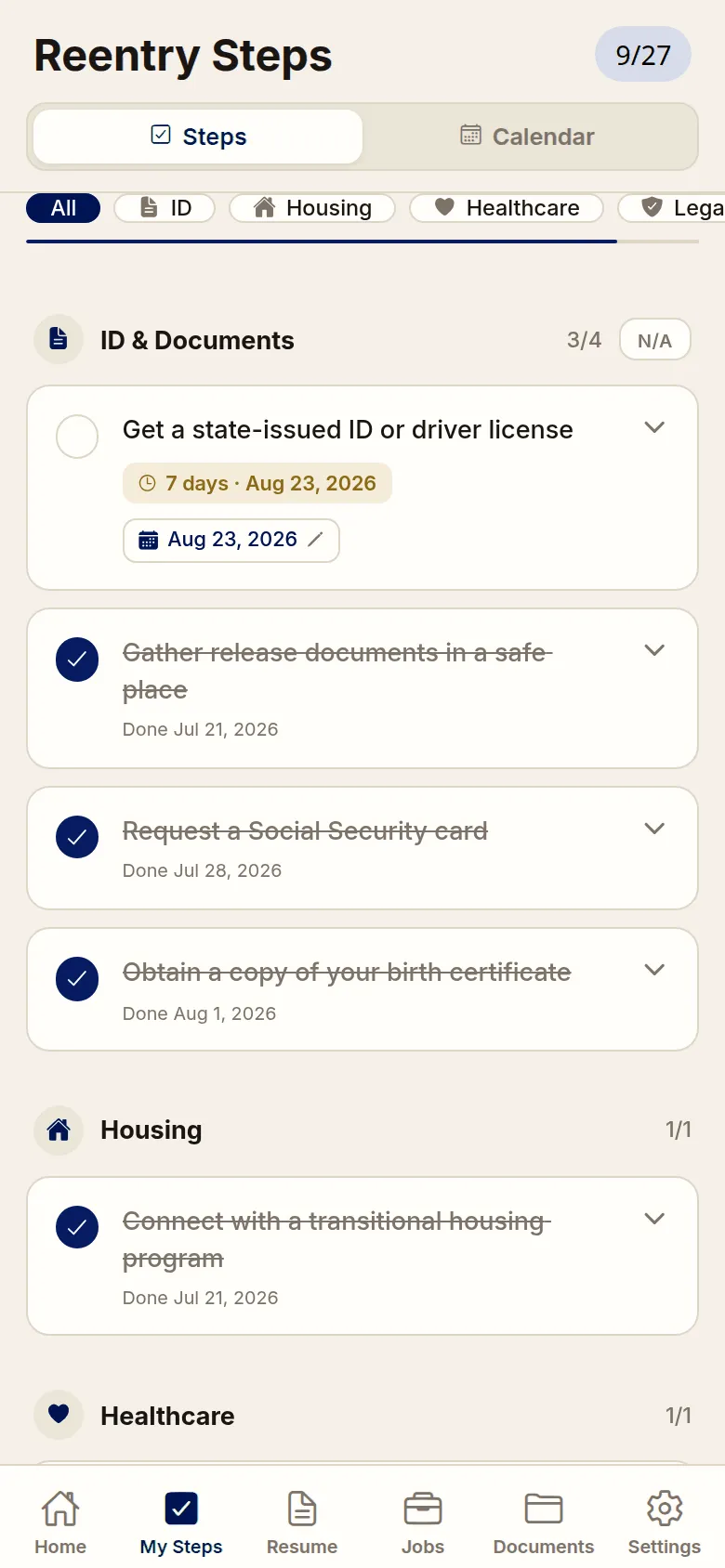
27-Step Checklist
• Every step in the order it actually happens
• A due date and a reminder on each one
• ID, housing, healthcare, legal and work
• Fewer calls asking what comes next
Free

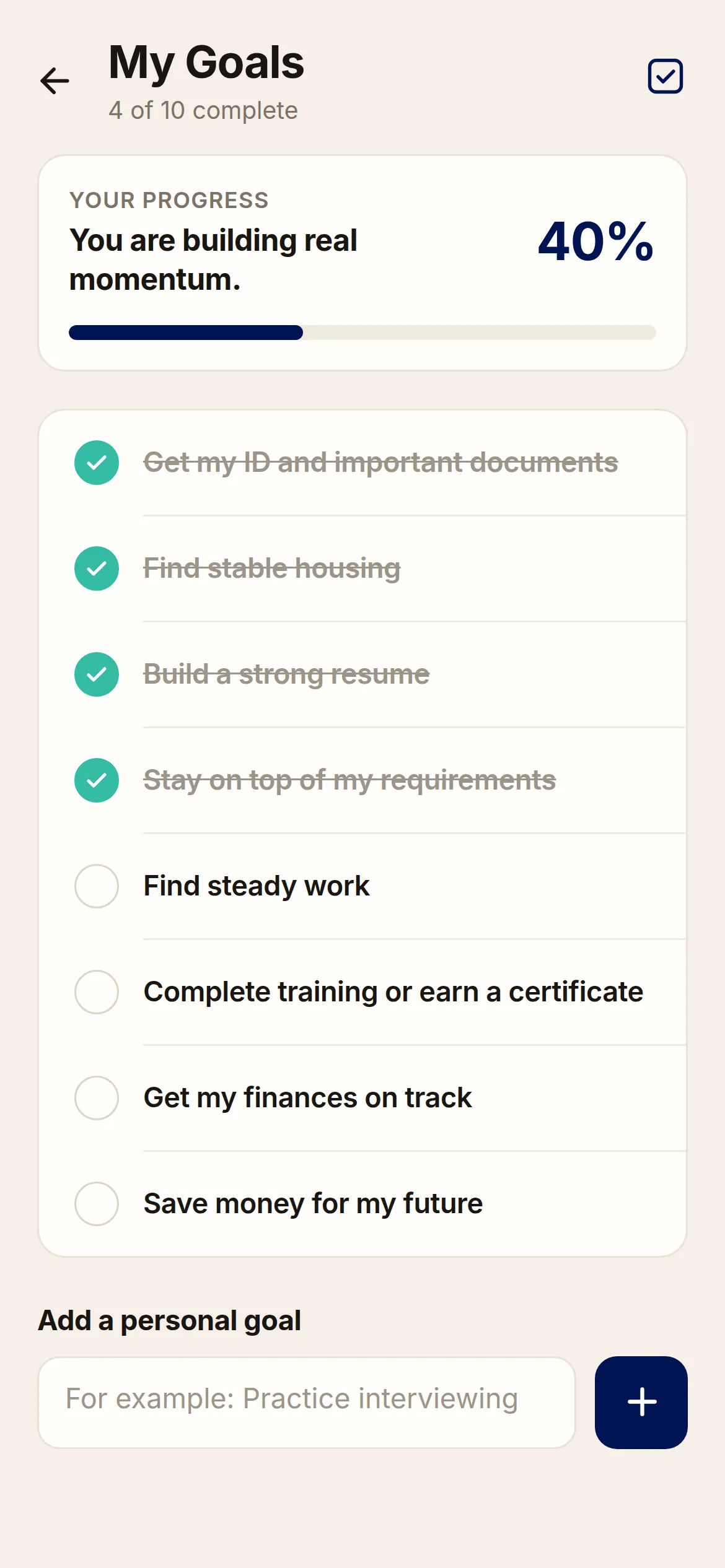
Goals & Progress
• Ten starter goals, plus their own
• A bar that shows how far they have come
• Free permanently, no card required
• Motivation you cannot mandate
Free

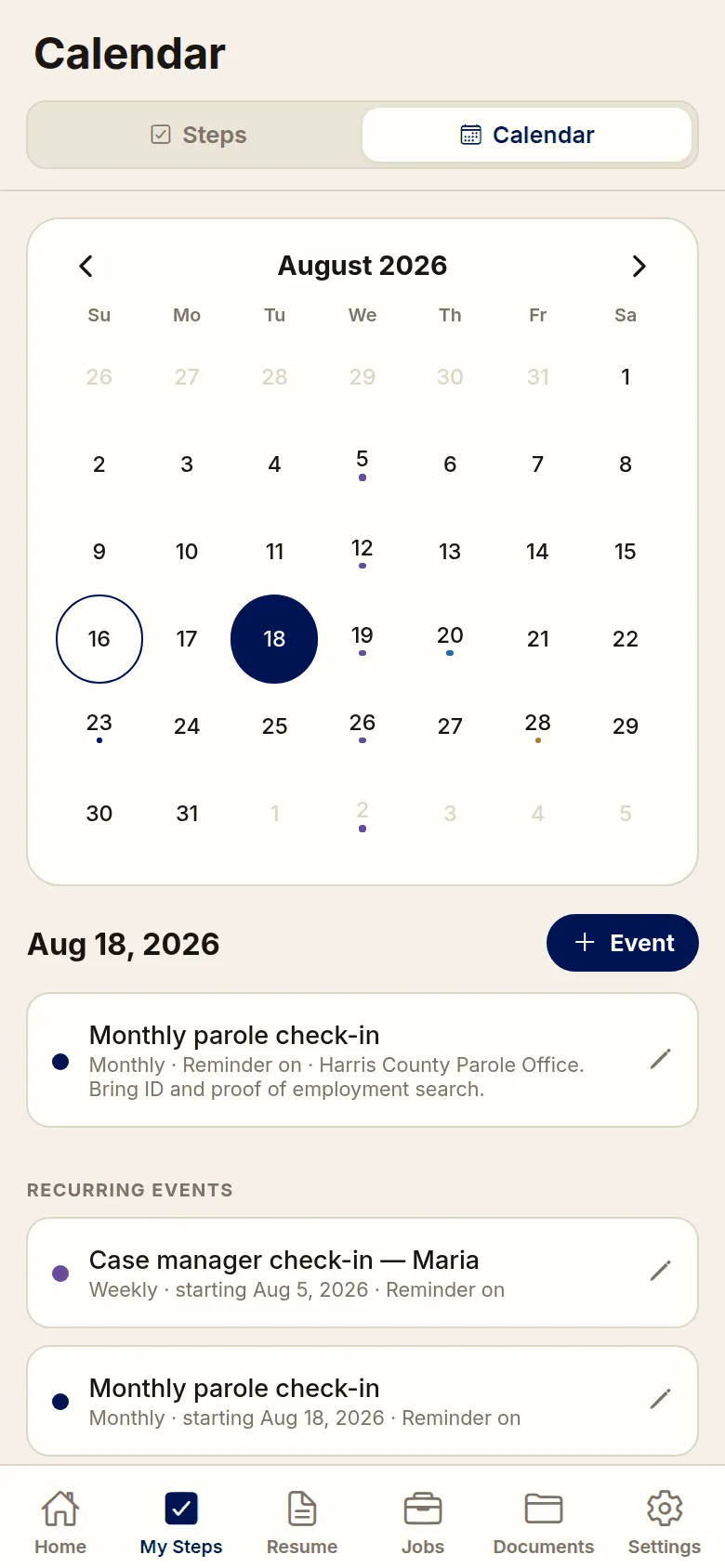
Calendar
• Check-ins, court dates and deadlines in one view
• Reminders land before the date, not on it
• Tied to the checklist, so nothing splits in two
• Every date from the court and the officer in one place
Free

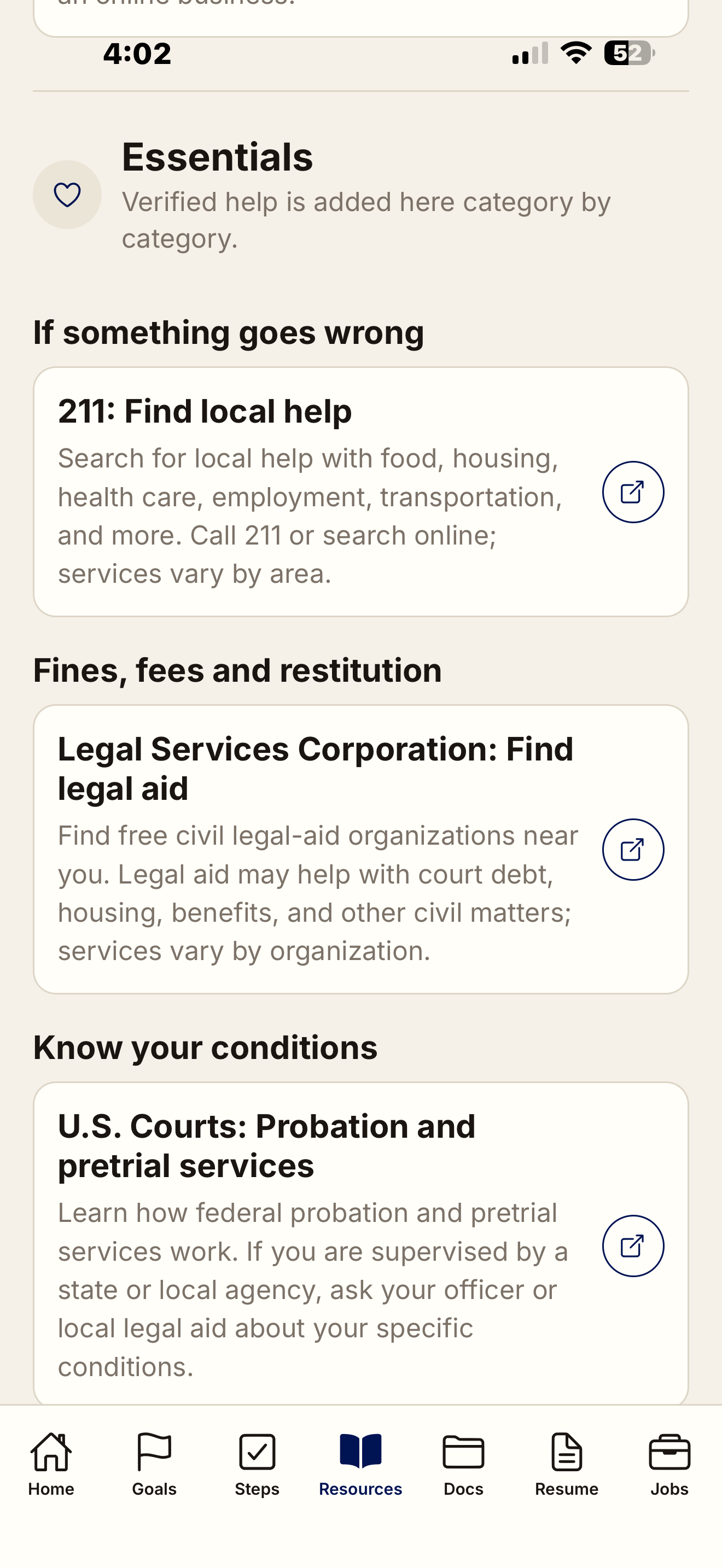
Resources
• Verified links for housing, benefits, health coverage and legal aid
• 211 for local services, and plain answers on supervision conditions
• ID, driver's license, child support, school and job licensing
• Partners for building credit, car insurance and starting a business
• Free on every tier
The question we get asked most
It is one of the first things people ask us, so we would rather answer it here than leave anyone wondering. Nothing in the app reports back to an organization. We cannot tell you who opened it, what anyone checked off or what dates they put in. Document photos are encrypted on the phone before they are uploaded, and we store only the encrypted file.
We say it plainly because being comfortable with it is the whole thing. Someone who is not sure who might be reading will not put a real court date in, and an app nobody opens is no use to them, or to you. So there is no dashboard on your side — here is what you can see instead.
Walk the checklist, the calendar, the vault and the job board yourself on the demo login, and decide whether it is something you would hand to someone on their first day home.
Ask them how they got on. One thing we would ask in return: make it easy to wave off, and let them know that saying they did not use it, or did not like it, changes nothing — not with you, and not their access, which is theirs to keep either way.
If you want something written down, ask us for the one-page question sheet. You administer it, you keep it, and none of it comes to us. And if your evaluation office wants something more rigorous than that, our standing offer holds: we will support a real study and publish the result either way.
The problem, in your own numbers
Every figure below is from the Bureau of Justice Statistics or the Council of State Governments Justice Center. Full citations are at the bottom of this page.
40%
of state prison admissions result from probation or parole violations
CSG Justice Center (2023 data)
110,000+
admissions in 2023 came from technical violations alone — not new offenses
CSG Justice Center (2023 data)
40%
Prison admissions from supervision violations
Two in five people entering state prison are returning on a probation or parole violation.
CSG Justice Center (2023 data)
Figures are national. Individual states vary widely.
What the evidence actually supports
Helping people show up. Here is what the research found, including where it stops.
Randomized controlled trial
In New York City, 23,243 people randomized: text reminders cut failure to appear by 8 percentage points from a 37.9% base — a 21% relative reduction. Messages combining consequence information with plan-making performed best, at 9.9 points.
Fishbane, Ouss & Shah, Science, 2020
Randomized controlled trial
In Santa Clara County, California, 5,709 people randomized: reminders cut bench warrants by 20.4% and incarceration from missed court dates by 21.4% — at roughly 60 cents per defendant per case.
Science Advances, 2025
Randomized controlled trial
Across all 54 Arkansas Community Corrections offices — 3,470 clients, 14,135 appointments — a single text one day before produced 29% fewer no-shows and 21% fewer cancellations.
Hastings et al., 2021
Meta-analysis
A meta-analysis of court-date reminder studies found reminders significantly reduce the odds of failure to appear, improving appearance in 11 of 12 studies reviewed. The authors caution that reminders are not a panacea.
Zottola et al., Criminology & Public Policy, 2023
Stated plainly
You will hear a lot of overstatement in this category, so here is ours.
No reentry app has published randomized evidence that it does. The one trial that directly tested whether reminders reduce probation violations found no significant effect.
Those are different measures and we will not conflate them.
Everything on this page is peer-reviewed or from a federal statistical agency.
We will support a real study and publish the result either way.
How a jurisdiction offers it
01
Free. We give you printable cards and a QR code for release packets, probation offices and reentry centers. Nothing to procure, nothing to sign, no data flows to us.
02
We build and maintain the county layer for your jurisdiction — your probation office, your courts, your general assistance office, your transit program — so the steps and the resources people see are the real ones for where they live, not a generic list.
On surveillance
There is no location tracking, no check-in verification and no silent reporting to an agency. If we build anything an officer can see, the person will be told exactly what that is before it is turned on. That is also what makes people actually use it — and a tool nobody opens does not help you either.
See it for yourself
You do not need access to the people you supervise, and we would not give it to you. What we can give you is a demo account loaded with sample data, so you can walk through exactly what someone in your jurisdiction sees before you decide anything. The demo includes the full checklist and calendar, the document vault, the resume and cover letter builder, the second-chance job board and the application tracker — populated with realistic sample data, not a real person's information.
Tell us your organization and we will send login details the same day. No sales call required, and nothing is installed on your systems. Request credentials from contact@freeandforward.com
Paying for it
$111 million in the most recent cycle. Award ceiling $900,000. Reentry technology and case coordination are eligible uses.
Formula funding to state administering agencies plus direct local awards. Commonly used for supervision technology and reentry services.
$110 million for program year 2026, with up to $30 million to national and regional intermediaries.
Justice-involved individuals are a priority population for local workforce development boards.
Eighteen states approved as of September 2026 and more pending. Pre-release case management and care coordination are covered services.
Many states carry a dedicated line. We will help your grants office write the technology component.
Talk to us
Roughly how many people you supervise or release a year, and what the problem is. We will tell you honestly whether we can help.
Sources: Council of State Governments Justice Center, Supervision Violations and Their Impact on Incarceration, 2025 report (2023 data) · Fishbane, Ouss & Shah, “Behavioral nudges reduce failure to appear for court,” Science, 2020 · Chohlas-Wood et al., Science Advances, Santa Clara County court reminder trial, 2025 · Hastings et al., Arkansas Community Corrections appointment reminder trial, 2021 · Zottola et al., Criminology & Public Policy, 2023 · Medicaid.gov, Reentry Section 1115 Demonstrations (September 2026).